
January 2027 Tariffs: What a One-Cabinet Test on Hong Kong Island Still Tells Us
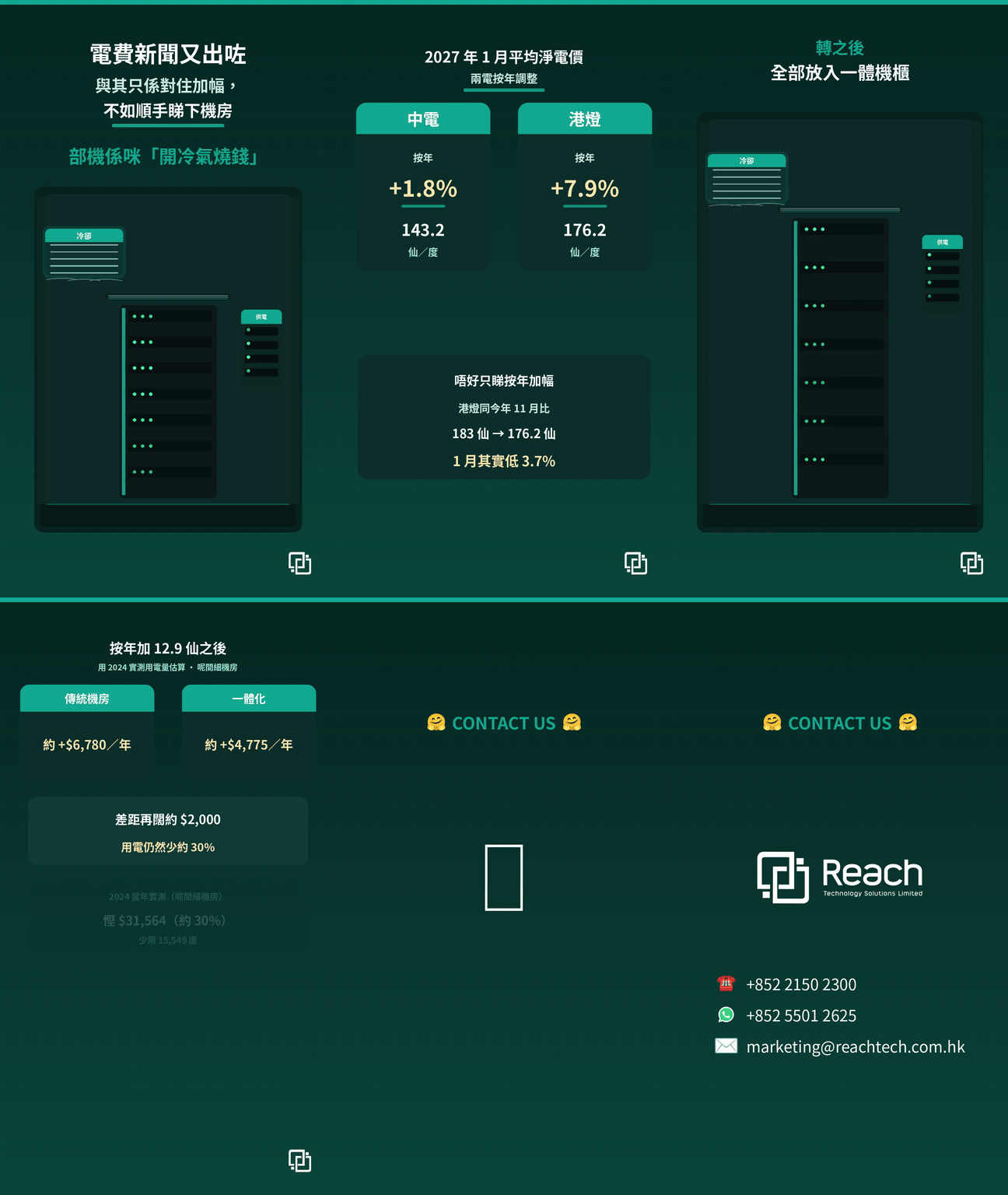
Once the tariff figures are out, it is a good moment to look at the server room — not only the percentage on the bill, but whether the kit is quietly “running the air-con and burning money.” On 24 November 2026, CLP and HK Electric announced their adjustments for January 2027; ReachTech was not involved in that announcement. We simply want to revisit a real test we published in January 2024: a small server room on Hong Kong Island that housed one rack, after which the power, cooling and other facilities serving that rack were moved into a SmartCabinet (all-in-one cabinet). The point is not to restate the rise, but to see, at that same scale, how much the electricity bill can differ when power is used differently.
1. The January 2027 tariff news — including the November contrast
According to RTHK (24 November 2026), CLP’s average net tariff for January 2027 rises 1.8% year on year, to 143.2 cents per kWh. HK Electric’s average net tariff rises 7.9% year on year, to 176.2 cents per kWh.
The year-on-year figure for HK Electric should be read with one further comparison, so it is not misleading. HK Electric’s own announcement, and a same-day RTHK report, note that January 2027 is actually 3.7% lower than November 2026, when the average net stood at 183.0 cents per kWh.
Officially, the average net was 163.3 cents in January 2026 and will be 176.2 cents in January 2027 — 12.9 cents more, or 7.9% year on year versus January, and 3.7% lower than November. The estimate later in this article uses that official 12.9-cent year-on-year difference.
2. The 2024 test: one cabinet, not a whole facility
In January 2024, ReachTech published a real test on Hong Kong Island (HK Electric territory). The site was a small server room that housed one rack, together with the power, cooling and other facilities needed to serve that rack. The comparison is before and after: a traditional room serving that one rack, versus having everything inside a SmartCabinet (all-in-one cabinet). It was not a multi-rack facility, and the figures below should not be read as if they were.
The IT load was 3 kW. The traditional room was calculated at a PUE of 2.0. The all-in-one cabinet ran in ECO mode; the building’s central air-conditioning operated Monday to Friday, 8am to 7pm, and the cabinet’s own cooling came on automatically when the central system was off.
The published 2024 results were a traditional annual bill of HKD 106,696, against HKD 75,132 for the all-in-one cabinet — a saving of HKD 31,564, or about 30%, and 15,549 kWh. The same published carousel also stated 11,040 kg CO2e and 442 trees; those are the 2024 published test figures, not numbers re-derived for this article.

Electricity use is consistent with a 3 kW IT load running all year at PUE 2.0: about 52,560 kWh for the traditional setup, and about 37,011 kWh for the all-in-one cabinet. The 2024 dollar figures used a flat rate of about HKD 2.03 per kWh, following the Island unit rate used for that test at the time — not an inflated rate. That is a different basis from the official average net tariff, which in January 2024 was 165.5 cents per kWh (basic tariff 119.5 cents plus a fuel clause charge of 46.0 cents). We note this only so the two bases are not mixed later.
3. What an all-in-one cabinet changes about electricity use
A SmartCabinet is not simply a way to put equipment into a single rack. In a traditional small server room, power and cooling are often installed separately on the walls or in the ceiling. An all-in-one cabinet brings cooling, power distribution and UPS, together with the IT load, inside the cabinet itself. That reduces how much the room itself has to be altered, and it lets cooling run closer to the actual load, instead of air-conditioning the whole room harder than it needs to. For smaller rooms, packing those facilities into the cabinet also usually takes less floor space.
The design itself is meant to be energy-efficient: more effective cooling, less unnecessary electricity use, and therefore a lighter bill. In the 2024 test, the all-in-one cabinet ran in ECO mode, and its own cooling came on when the building’s central air-conditioning was off — cooling on demand, in other words. At that 3 kW, one-cabinet scale, the published result was about 30% less electricity, a saving of HKD 31,564, and 15,549 kWh less use. That is not a promise that every room will see the same figures. It only shows that when power and cooling are organised more efficiently, electricity use and the annual bill can differ by a meaningful amount — and that a year-on-year tariff change makes that difference easier to see on the bill.
4. What the year-on-year rise means at that 3 kW scale
For the 2027 angle, we take the 2024 test’s kWh figures and apply only HK Electric’s official year-on-year increase of 12.9 cents (176.2 minus 163.3). We do not recalculate the 2024 bills at 176.2 cents, and we do not present HKD 106,696 / HKD 75,132 as a “before and after” the hike. The news figure is the published average net tariff; the 2024 test priced the bills at the Island unit rate used at the time.
On that 12.9-cent year-on-year difference alone, the traditional setup would see about an extra HKD 6,780 a year. The all-in-one cabinet would see about an extra HKD 4,775 a year. The gap widens by about HKD 2,000. The savings share stays about 30%, because the underlying kWh difference has not changed.
The 2024 result (HKD 31,564, about 30%, and 15,549 kWh) remains that year’s one-cabinet test, clearly labelled. The 2027 news does not invent a new saving; it only shows that, at this 3 kW scale, a higher official average net tariff adds more in dollars to the heavier user of electricity. This estimate applies to the scale and tariff area of this Island test, not to every server room.
5. A timely look at cooling and power
A tariff announcement is a good moment to ask a calm question: in your room, how much of the bill is the IT load itself, and how much is cooling and the way power is used? Server rooms can be heavy on electricity, especially when cooling runs harder than it needs to.
Not every site is a small 3 kW server room on Hong Kong Island, with one rack and the facilities needed to serve it, later housed in a SmartCabinet, and the same dollars will not appear everywhere. What the 2024 test shows, at that scale, is that moving cooling and power into an all-in-one cabinet, and organising them more efficiently, can change the annual bill by a meaningful amount — and that a year-on-year tariff rise lands more heavily on the less efficient setup.
If you would like to talk about a room refresh, a SmartCabinet (all-in-one cabinet), or server-room power and cooling efficiency, we would be glad to listen. No hard pitch — just a conversation about whether a closer look would be useful.
ReachTech professional scope
ReachTech provides data centre and server room infrastructure services, including a complimentary on-site assessment and an integrated proposal:
✅ Server room design and all-in-one smart cabinet solutions
✅ UPS power backup systems
✅ Precision cooling
✅ Complete office IT relocation
🤗 CONTACT US
☎️ +852 2150 2300
✅ +852 5501 2625
Sources
RTHK: CLP’s January tariff to rise 1.8% year on year (24 November 2026)
HK Electric press release: HK Electric 2027 Tariff Adjustments (24 November 2026; official year-on-year rise, 163.3 cents, 12.9 cents and the November contrast)
HK Electric press release: Fuel Costs Fall Brings 16% Reduction in Net Tariff (28 November 2023; official January 2024 average net tariff of 165.5 cents, being basic tariff 119.5 cents plus a fuel clause charge of 46.0 cents)


