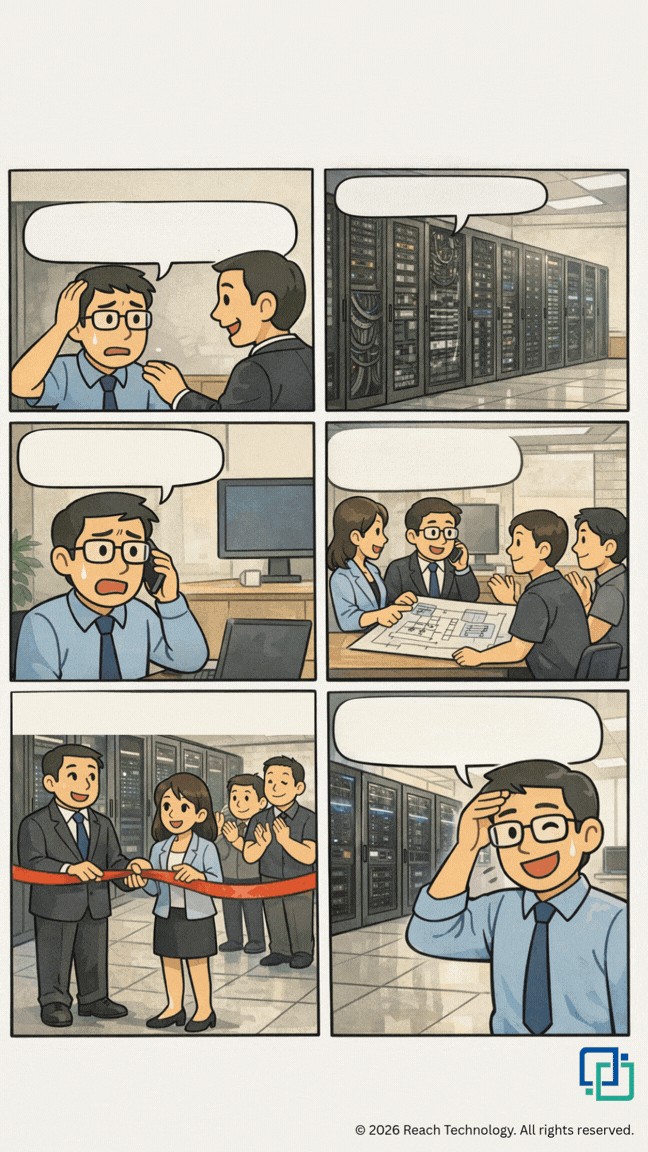
6 Server Room Location Selection Tips: Avoid Costly Modifications Lateron
Updated: Jul 24

In office relocation or renovation projects, the choice of server room location is often underestimated. Many companies assume they can simply pick any available room to house their servers, overlooking the significant impact that site selection has on system stability, operating costs, and future scalability.
Inadequate planning in the early stages can lead to expensive modifications later — or even disrupt normal business operations. Below are six critical factors that must be carefully evaluated when selecting a server room location.
1. Avoid Exterior Walls and Windows
Locations near exterior walls and windows are more affected by external temperature fluctuations, resulting in higher cooling costs and greater temperature instability.
Common Mistake
Placing the server room against an exterior wall or in a space with large windows for convenience or space-saving reasons. This significantly increases cooling load and long-term operating costs.
Professional Advice
Choose a room located in the central or internal area of the building to maintain more stable environmental conditions. ReachTech can conduct on-site environmental assessments to help clients select the most suitable location and provide efficient cooling solutions.
(Reference: TIA-942 standard and industry consensus)
2. Avoid Water Pipe Risks
Never locate the server room above or below toilets, kitchens, or areas where water pipes pass through.
Common Mistake
Ignoring the potential risk of water pipes and placing the server room too close to plumbing systems. A single leak can cause severe damage.
Professional Advice The server room should be kept away from all water pipes and high-humidity areas. Installation of water leak detection systems is strongly recommended. ReachTech performs comprehensive environmental risk assessments during server room design to prevent such hazards.
(Reference: TIA-942 standard and Data Center Knowledge)
3. Power and Cooling System Capacity
The server room must have sufficient redundant power circuits and adequate HVAC capacity.
Common Mistake
Calculating power and cooling requirements based only on current equipment, without reserving capacity for future expansion. This often results in insufficient power or cooling when additional cabinets are added later.
Professional Advice
Plan for power and cooling needs over the next 3–5 years of equipment growth and reserve adequate redundant capacity. ReachTech provides professional power load assessments and cooling solution planning, including all-in-one intelligent cabinets and precision air conditioning systems.
(Reference: Uptime Institute Tier standards and ASHRAE TC 9.9)
4. Floor Load and Seismic Considerations
Heavy cabinets, liquid cooling systems, high-density HPC cabinets, large UPS units, and battery banks place significant demands on floor load capacity.
Common Mistake
Failing to assess the structural load capacity of the floor and placing heavy equipment on upper floors or standard office floors, creating potential structural safety risks.
Professional Advice
Heavy equipment should preferably be placed on lower floors, or a floor load assessment should be conducted in advance. Load spreading measures can be applied when necessary. ReachTech can assist clients with load-bearing evaluations and structural planning for the server room.
(Reference: Industry data center design standards recommending a minimum floor loading of 150 PSF)
5. Proximity to the Main Network Backbone
The server room should be located as close as possible to the building’s main network backbone to facilitate structured cabling and future expansion.
Common Mistake
Placing the server room too far from the main network entrance, making future cabling difficult and costly, and potentially affecting network performance.
Professional Advice
Prioritize proximity to the network backbone during site selection and reserve sufficient space for structured cabling. ReachTech has extensive experience in structured cabling and can ensure that the server room’s network infrastructure is properly planned and scalable.
(Reference: TIA-942 structured cabling standard)
6. Reserve Maintenance Aisles and Expansion Space
Adequate maintenance access must be reserved in the server room design to allow for future equipment servicing and replacement.
Common Mistake
Designing a server room that is too narrow, making it impossible to open cabinet doors for maintenance, or failing to reserve space for future cabinet additions.
Professional Advice
Reserve at least 1 meter of maintenance aisle space. Also consider the impact of noise on surrounding office areas and future expansion needs. ReachTech’s intelligent cabinet solutions emphasize high density and ease of maintenance, effectively addressing space and accessibility challenges.
(Reference: TIA-942 / BICSI data center design best practices)
ReachTech’s Professional Services
ReachTech has extensive experience in data center and server room infrastructure. We provide professional site selection assessments and complete solutions for enterprises, including:
✅ Server room design and all-in-one intelligent cabinet solutions
✅ UPS power backup systems
✅ Precision cooling solutions
✅ Complete office IT relocation services
We help clients avoid common issues during the early planning stage, ensuring the server room design meets actual requirements and supports future growth.
Server room site selection should be planned early. A professional assessment at the beginning can effectively prevent costly modifications and operational risks later.
If you are planning an office relocation or server room upgrade, feel free to contact ReachTech to arrange a free server room site selection assessment.
🤗 CONTACT US
☎️ +852 2150 2300
❇️ +852 5501 2625
References
Wikipedia – Server room https://en.wikipedia.org/wiki/Server_room
ANSI/TIA-942 Telecommunications Infrastructure Standard for Data Centers
ASHRAE TC 9.9 – Thermal Guidelines for Data Processing Environments
Uptime Institute – Tier Classification System https://uptimeinstitute.com/tiers
Data Center Knowledge – Data Center Plumbing: A Guide to Cooling, Efficiency, and Sustainability https://www.datacenterknowledge.com/infrastructure/data-center-plumbing-a-guide-to-cooling-efficiency-and-sustainability
TechTarget – Data center design standards for cabinet and floor loading https://www.techtarget.com/searchdatacenter/tip/Data-center-design-standards-for-cabinet-and-floor-loading